The ASEAN Peatland Management Strategy (APMS) 2006-2020 was developed in 2005 and adopted by ASEAN in 2006. Based on the Final Review of the APMS – completed and agreed by the ASEAN Member States in January 2021 – it was recommended that a new APMS 2022-2030 should be reformulated to maintain and scale-up action for sustainable peatland management in the region. The development of the new APMS 2022-2030 is being supported by Sustainable Use of Peatlands and Haze Management in ASEAN (SUPA) Programme Component 1.
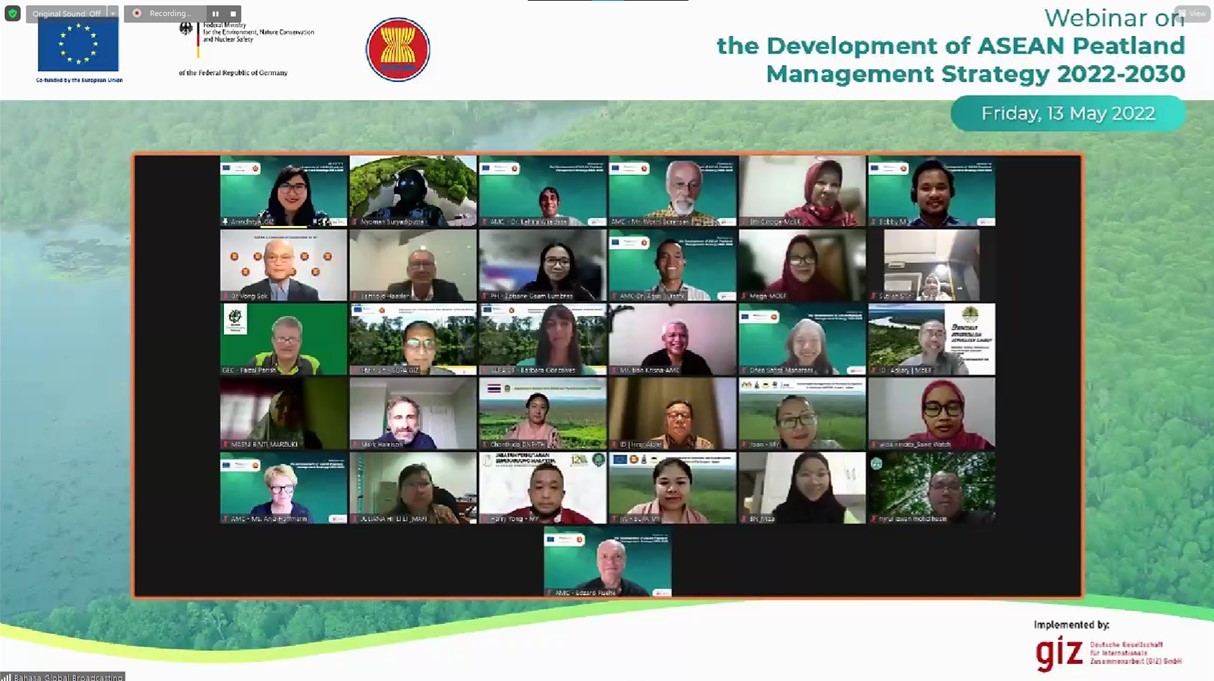
As part of the formulation of the APMS 2022-2030, a Webinar on the Development of a New ASEAN Peatland Management Strategy 2022-2030 (APMS 2022-2030) was conducted on 13 May 2022. The Webinar aimed to provide an opportunity for wide ranging stakeholders including experts, national authorities and NGOs to give their inputs and expert opinion in the new APMS 2022-2030. The Webinar was attended by 132 participants, consisted of the Task Force Members for the Development of the new APMS 2022-2030, representatives from the Committee under Conference of the Parties to the ASEAN Agreement on Transboundary Haze Pollution (COM AATHP), ASEAN Task Force on Peatlands (ATFP), Senior Officials Meeting of the ASEAN Ministers on Agriculture and Forestry (SOM-AMAF), ASEAN Senior Officials on Forestry (ASOF), ASEAN Peatland Partners, non-governmental organisations (NGOs), universities and research institutions from the ASEAN and other regions, as well as private sectors.
Dr. Vong Sok, Head of Environment Division of the ASEAN Secretariat and Mr. Muamar Vebry, Programme Manager for Climate Change, Delegation of the European Union (EU) to ASEAN delivered their opening remarks at the Webinar. Dr. Vong emphasised the importance of peatland management in ASEAN in addressing transboundary haze pollution, with APMS as a workplan to address the pressing need for wise use and sustainable management of peatlands. He also underlined the result of the Final Review of the previous APMS (2006-2020) which reaffirmed the values of sustainable peatland management in the region by means of collective actions and enhanced cooperation. Mr. Vebry highlighted that the EU and the German Government, through SUPA Programme, have been supporting the Final Review of the initial APMS 2006-2020 as well the development of the new APMS 2022-2030. He also conveyed that the EU, as the region which also has significant peatland areas, would be pleased to share lessons learn and knowledge in peatland management.
The consultants from Asian Management Consulting (AMC) presented the focal areas and action plan of the new APMS, followed by discussion session. Then, all participants were divided into four breakout sessions on different topics, where they discussed and gave technical feedback through Mural board.
The inputs from the Webinar are found to be wide ranging with invaluable insight for the development of a new ASEAN Peatland Management Strategy 2022-2030, particularly for the new APMS 2022-2030 to be developed as an ambitious and robust strategy in addressing the challenge in peatland management in the ASEAN Region.
Following the Webinar, AMC would incorporate the insights received to develop the draft new APMS 2022-2030 to be further discussed and adopted by the ASEAN Member States.